


The automatically translated article is temporarily displayed. We are working on the translation to publish the completed English version.
**********
"Sumi-e" creates infinite colors and emotions from the extremely simple materials of ink and paper. His tranquil aesthetic, which pursues harmony with nature and the spiritual world through the force of the brush, the shading of the ink, and the blank space of the paper, has recently attracted a lot of interest in the art scene overseas.
This article will explain everything from the historical background to how to choose art materials and basic drawing methods from a unique PIGMENT TOKYO perspective, for those who want to systematically understand the profound world of sumi-e and those who want to start painting ink.
Contents
1. What is Sumi-e? A monochrome world that goes beyond color
The origin of this unique evolution in Japan lies across the ocean in mainland China. Although it is a monochrome world, its greatest appeal is that it evokes a rich scene and atmosphere in the viewer's mind through the gradation of the ink and the strength and weakness of the strokes.
Zen philosophy and Japan's unique aesthetic sense
Sumi-e is not just a depiction of a landscape; it is an art form that embodies the spiritual world of "simplicity," "introspection," and "oneness with nature," which Zen values.
The essence of Japanese aesthetics is condensed in the fleeting brushstrokes that cannot be undone, and in the composition of the "margins" that give depth to the undepicted space.
Origin and characteristics of sumi-e: Differences from Chinese ink painting
In modern times, they tend to be treated as synonyms, but "Sumi-e" refers to all paintings drawn with ink, and "Suibokuga" refers to a style unique to the East that makes full use of the shading and blurring of ink.
This technique was born in China during the Tang Dynasty and was brought to Japan with Zen Buddhism during the Kamakura period. In contrast to China's emphasis on majestic and detailed depictions, Japanese sumi-e has evolved into a concise and poetic style of expression that eliminates unnecessary details. The fusion of Japanese climate and Zen spirituality has developed into a unique and sophisticated style.
2. How to choose art supplies

When starting out with sumi-e, choosing high-quality art materials will deepen the worldview of your work.
If you have "ink", "inkstone", "brush", and "Washi paper", you can start today. Other utensils can be substituted with containers or spoons you have on hand.
At PIGMENT TOKYO, we have a wide selection of highly specialized, high-quality art supplies, including traditional Japanese brushes, ink, and washi paper, so please try finding the art supplies that suit you.
Ink Sticks & Inkstones
Solid ink sticks, along with the inkstones used to produce their color, form the foundation of sumi-e. Although the ink may appear uniformly black at first glance, variations in raw materials and crafting methods endow each stick with a subtle, distinct character. By adjusting the concentration of the ink, you can create infinite depth through delicate gradations. Discover the perfect piece to match your desired artistic style.
Ink sticks
Oil smoke ink is suitable for a wide range of expressions, from light ink to dark ink, with deep warmth and deep colors. It is also ideal for portraying a solid, solid impression.
Pine smoke ink is characterized by a quiet, bluish tone. Especially when using light sumi ink diluted with water, the transparent colors stand out beautifully, giving the work a tranquil atmosphere.


[Related article] The special feature article on Sumi explains each theme in detail.
The basics of Japanese ink and the secret of ink color
Special feature article on Daiwagaboku
Inkstones

The beauty of the shading and blurring of ink is directly connected to the worldview of sumi-e works. By polishing solid ink with an inkstone, the particles become finely dispersed in the water, creating rich tones.
By using a high-quality inkstone that allows ink to flow smoothly, you can bring out the soft tones and transparency of light ink, which is essential for the production of sumi-e, to the maximum. For this reason, PIGMENT TOKYO recommends Chinese inkstone, which has a fine stone quality.
Inkstone product list for solid ink
[Related article] Basic information about inkstones
Brushes
The brush is perhaps the most vital tool in sumi-e. Because the trajectory of every stroke is transferred directly onto the paper—capturing the pure energy and expression of the line—it is crucial to select the optimal brush for your creative vision.
This section focuses primarily on natural animal-hair brushes made using traditional Japanese craftsmanship.
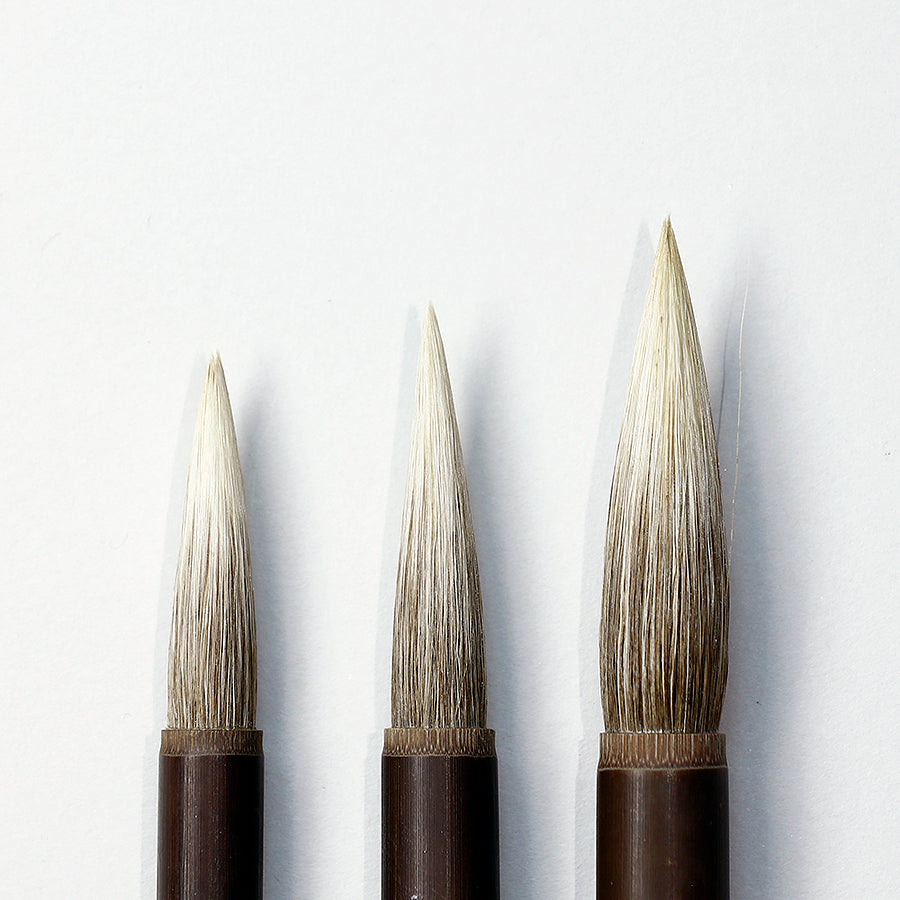
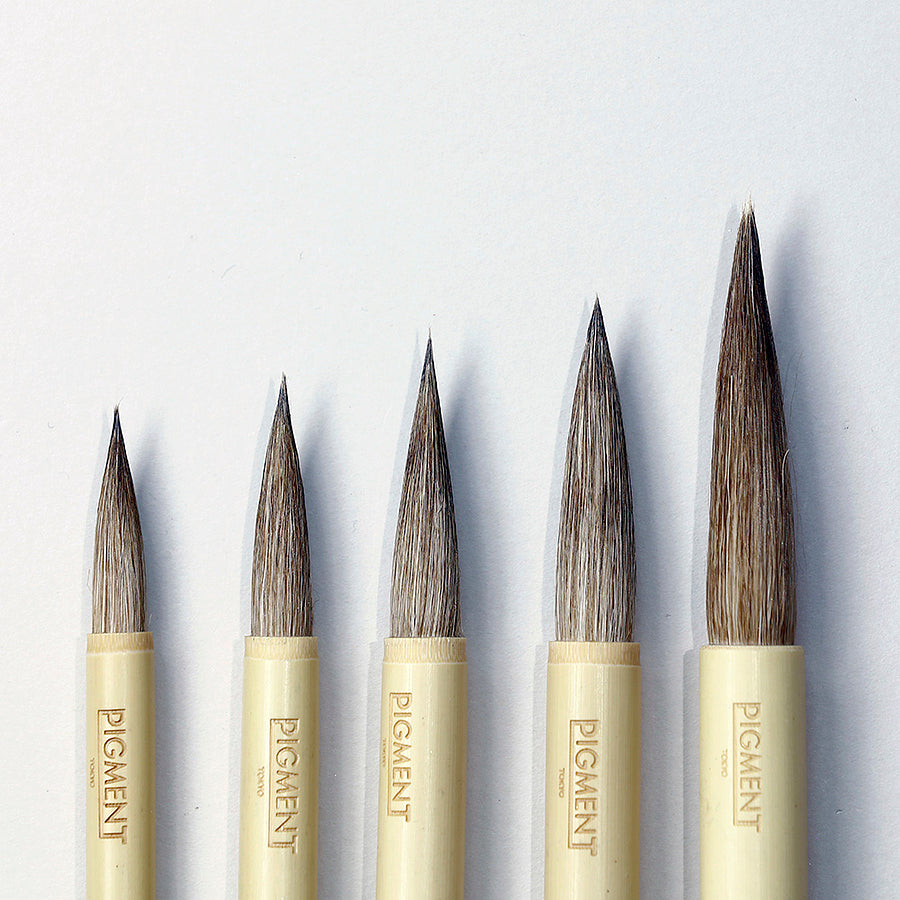
Strong, Structural Lines
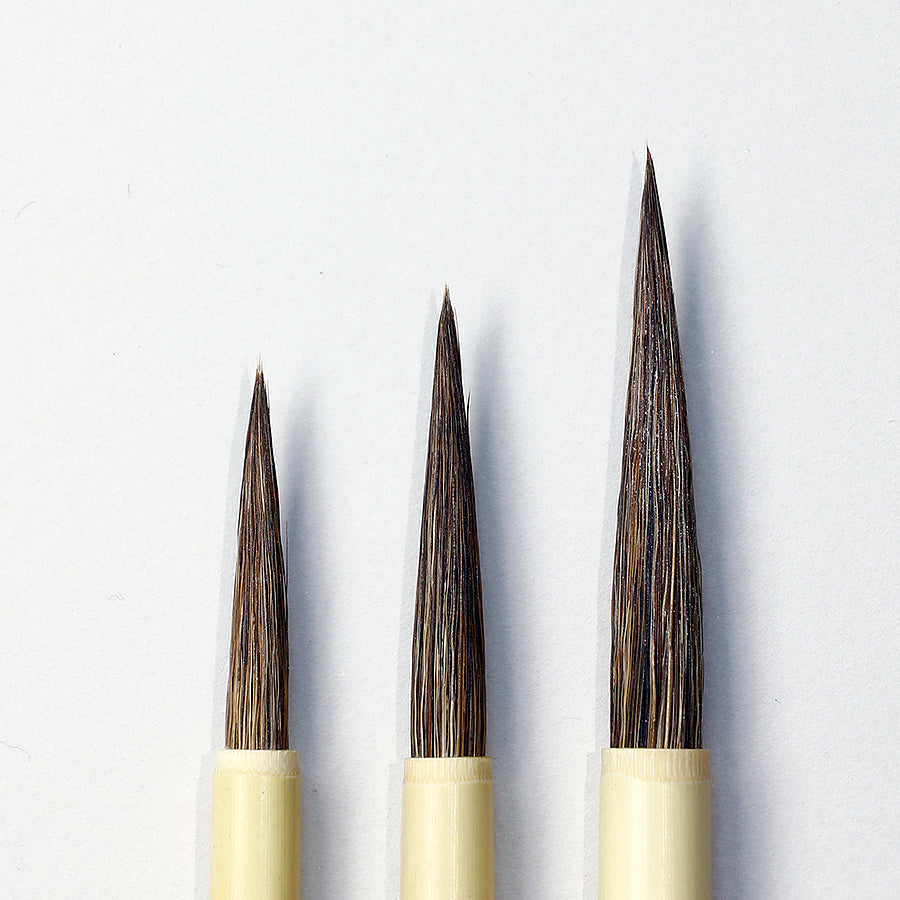
Brushes made of resilient hair—such as weasel or horse—or blends incorporating softer fibers are ideal for this style. Offering a balanced firmness and flexibility, these brushes help render the ridgelines of mountains that convey volume and power, as well as the taut, crisp lines needed for details like bamboo nodes.
Example Motifs: Mountains, Bamboo, etc.
Blur / Bokashi
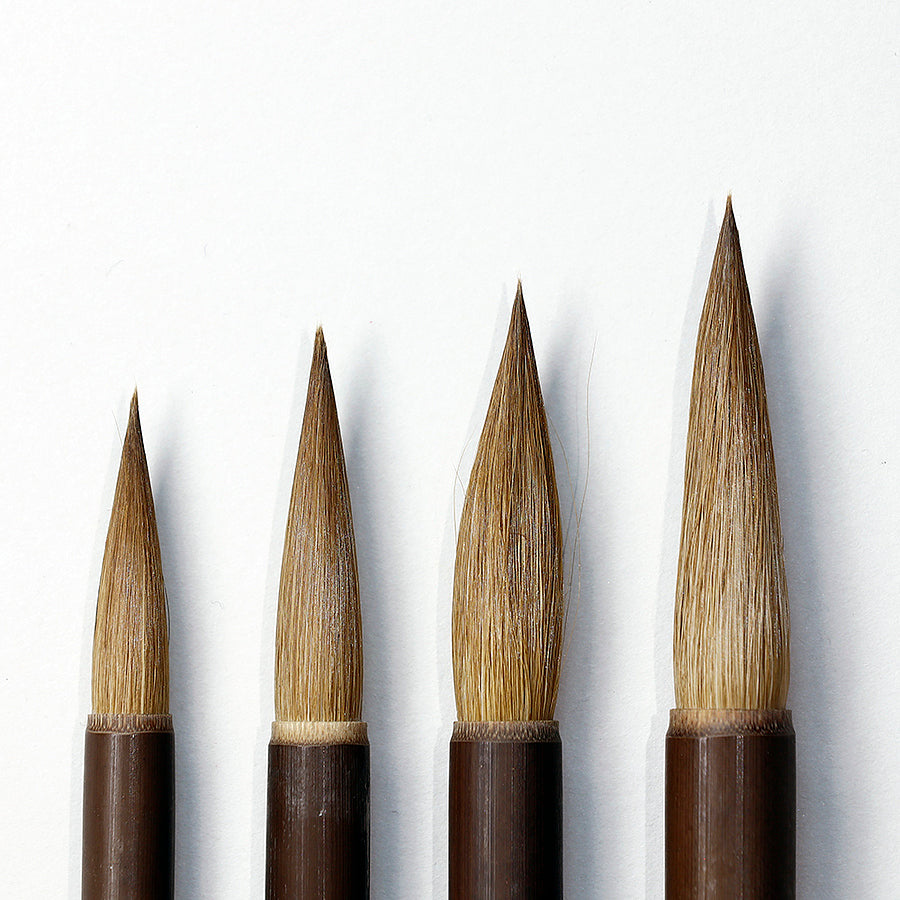
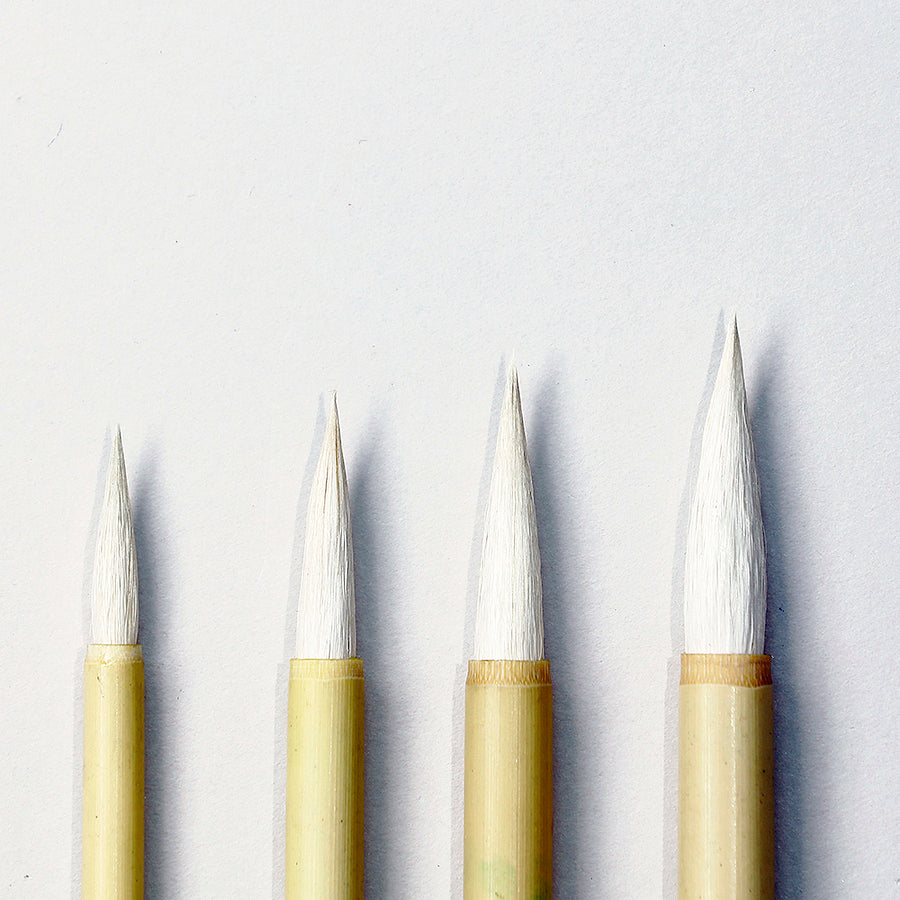
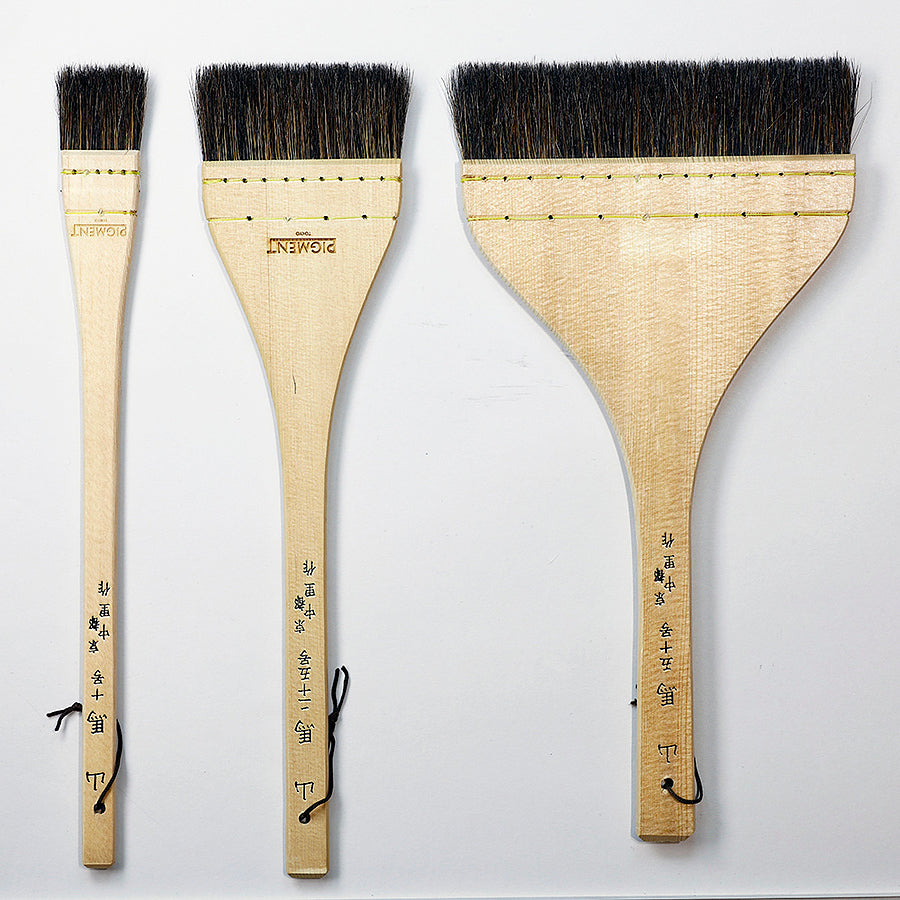
Brushes and brushes made of soft wool (goat) or bristles that retain moisture hold plenty of ink and water, making them excellent for creating natural "smudges" and "shades" on paper. It is also essential for expressing the lightness of clouds, the flow of water, and the soft texture of leaves.
It varies widely depending on the length and thickness (width) of the bristles of the brush.
Example Motifs: Leaves, Clouds, Water, etc.
Dry Textures
Dry the brush thoroughly and apply a small amount of dark ink to the tip of the brush before painting. The textures and nuances that appear on the paper vary depending on the characteristics of the brush used.
Example Motifs: Rock surface, Pine needles, etc.
・Brush with long and stiff tips
By running the brush vigorously, you can express the dynamic roughness and strength of the rock surface. Also, by using the length of the ears, it is possible to create lines with deep intonation.
・Short, hard ears
For fine strokes like pine needles, choose stiff, short ears such as deer hair. By taking advantage of the brush's strong repulsive force, you can achieve sharp and sharp blurring.
Recommended brushes for “the first step in sumi-e”
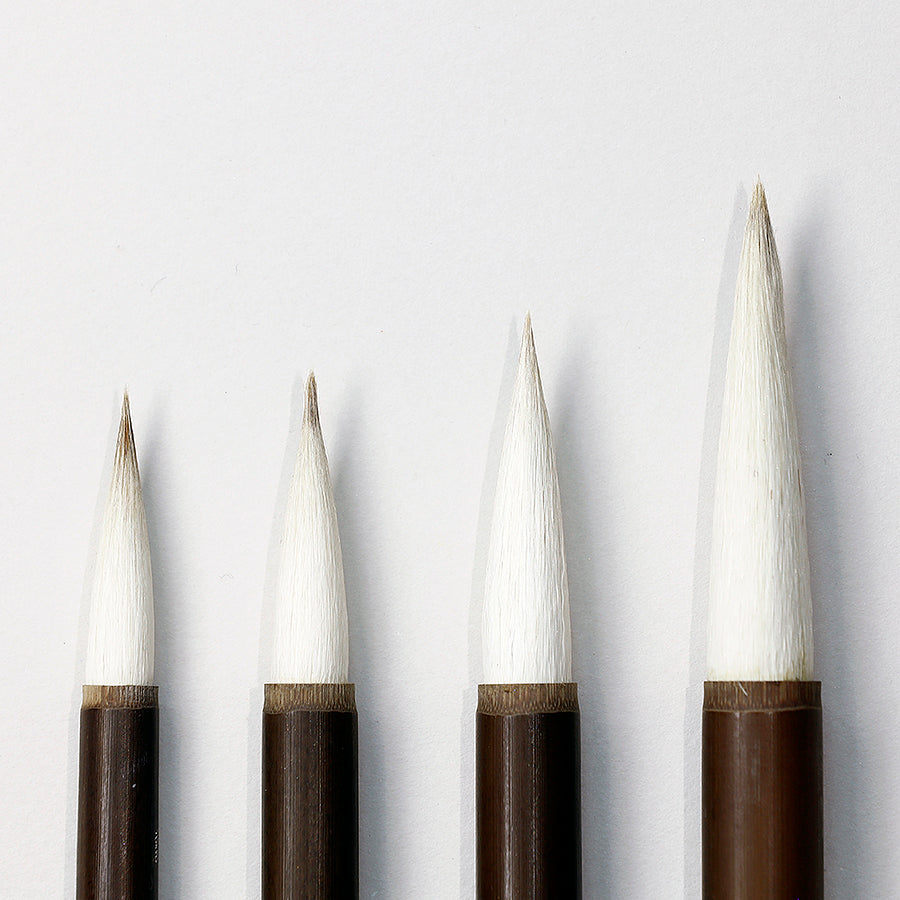
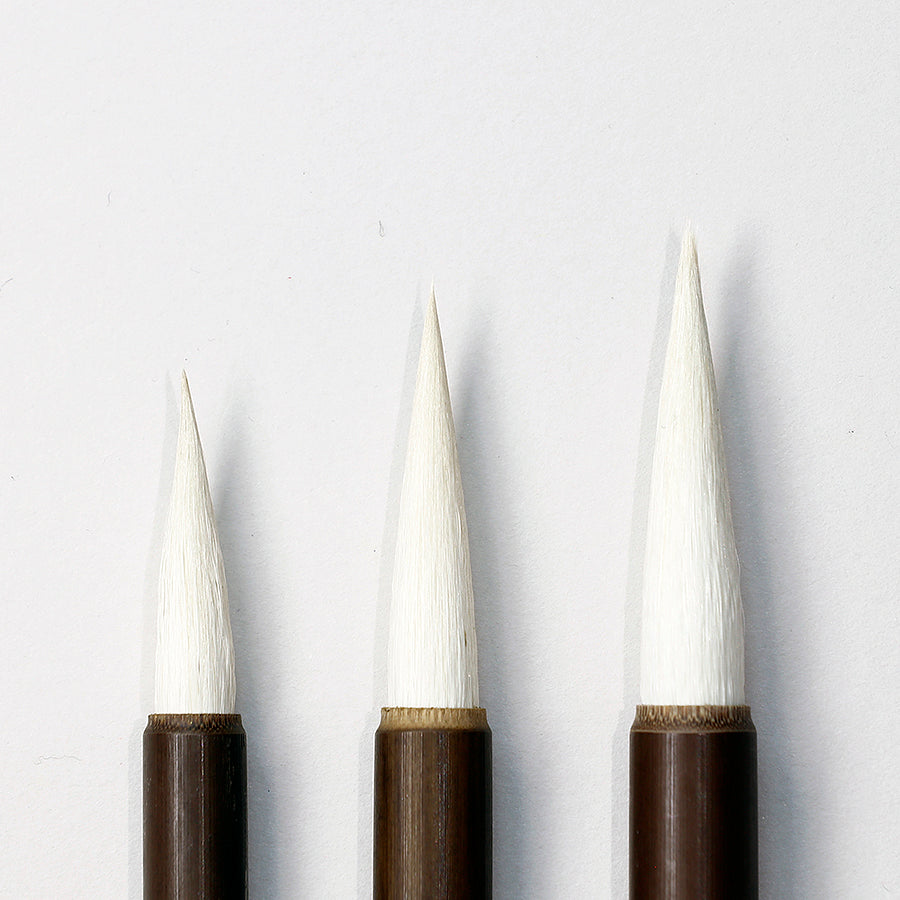
If you are trying out sumi-e for the first time, or if you want to try a variety of drawing methods with a single brush, try a medium-sized brush that has good ink content and is firm and supple.
It is suitable for learning basic brush strokes as it can handle a wide range of situations, from smooth line drawings to complex depictions. We recommend that you start by learning the basics and gradually move up to a style that matches your desired style and technique.
[Related article] How to choose brushes and their characteristics
Paper & Substraes
Sumi-e can be drawn on a variety of materials such as paper, silk, and boards, but depending on the base material, specialized ground preparation is required beforehand. Therefore, in this article, we will mainly introduce "Washi paper", which is easy to use even for first-time users.
Washi (Japanese Paper)
The unique texture and exceptional absorbency of Washi bring out the full charm of techniques like nijimi (ink bleeding) and kasure (dry-brush effect).
Paper comes in two main forms: raw, un-sized paper (nama), which retains its natural feel and high absorbency, and sized paper (dosa-biki), which has been treated with a liquid sizing agent to reduce bleeding. The presence or absence of this sizing treatment dramatically affects both brush control and the finished surface texture. Please refer to the comparison table and explanations below to select the paper best suited to your creative purpose.
|
type |
Features |
suitable expression |
|
No coating (raw) |
- Highly absorbent and ink bleeds quickly ・You can adjust it by pulling the dosa yourself. |
・Techniques that utilize “bleeding” and “blurring” ・Creating a lingering sound and a magnificent atmosphere through shading |
|
coated (Dosa sizing) |
・Water absorption is suppressed and ink penetrates slowly ・Prevents unintended bleeding |
・Sharp line drawing that clearly shows the outline ・Detailed depiction of every detail |
For practice / small art works
Until you get used to using ink and brushes, we recommend practicing with washi paper that is moderately thick and absorbent. "Art Card Bamboo Washi Ink Painting" is thick and available in postcard size, making it suitable for those who want to start drawing easily.

For Professional Artworks & Exhibitions
When creating pieces intended for long-term preservation or exhibition, highly durable Washi (Japanese paper) is the ideal choice. We recommend starting with foundational, plain papers such as "Hand-made Kozo Paper (Bleached, Un-sized)" or "Kumohada Mashi". As you become more accustomed to the medium, try incorporating highly decorative options like Unryu paper* to expand your range of artistic expression.
*Unryu paper: A type of Washi crafted by intertwining long fibers to create elegant, cloud-like patterns.


| Washi paper Product list |
[Related article]
Characteristics of Japanese paper and how to choose it
Types of Ekinu and basic usage
Other tools
In addition to the basic art supplies (ink, inkstone, brush, washi paper), we have compiled a list of useful items to have on hand. Please use this as a reference to help your production run more smoothly.
|
PIGMENTOKYO Recommended |
Tips on choosing a role |
|
Used for "Usuzumi" to transfer ink liquid and create shading of colors. |
|
|
For cleaning brushes Convenient type with separate rooms |
|
|
A spoon that adds water while finely adjusting the amount of water when polishing ink. |
|
|
Underlays such as "Mosen" *A cloth made by compressing wool etc. into felt. |
Absorbs ink and water that penetrates paper Prevents bleed-through and seepage into the workbench Appropriate elasticity makes it easier to draw lines |
|
paperweight (bunchin) |
Fix the paper to stabilize the strokes |
3. Bringing out beautiful black: How to make ink ink
We will introduce the basic steps for those who are just starting out with sumi-e, from the process of polishing the ink to the techniques for creating different shadings.
Rubbing Sumi Ink
Rubbing the ink can be considered a ritual for starting sumi-e.
Relax your shoulders, concentrate on the sensation of your fingertips, and slowly apply the ink while being enveloped by the soothing sound of scraping and the wafting scent. By making a thick, thick Rubbing ink liquid at this stage, the next process of "Choboku" will go smoothly.
For more information on how to polish, please refer to the video below and related articles.
[Related article]
Choboku (Ink Tone Adjustment)
The process of diluting freshly ground ink with water to create varying tones and shades is known as choboku. By preparing a spectrum of gradations—ranging from deep, concentrated ink (nouboku) to light, subtle ink (tanboku)—you can impart rich depth and three-dimensionality to your artwork.

Ink making on a plum plate
Steps of Choboku
1. Transfer the polishing liquid to a container
Transfer the thick ink liquid polished with an inkstone to a plate, etc. Please choose a container according to the amount used and the size of the brush. Plum plates are convenient for adjusting small amounts.
2. Dilute the dark ink
Add water to the undiluted ink (thick ink) and adjust the density according to the purpose. The drawing will be smoother if you check the color tone by making a trial drawing on washi paper and create several levels of ink color.
4. Cultivating brush strokes: Techniques and motifs
What is important in sumi-e is "enjoying the feeling of moving the brush" rather than technical skill. Here, we will introduce the basic brush strokes that you should first learn, which are the core of your expression.
What is important in sumi-e is "enjoying the feeling of moving the brush" rather than technical skill. Here, we will introduce the basic brush strokes that you should learn first.
*For recommended brushes, please also refer to the corresponding section in [2. How to choose art materials].
| ・Strong lines that form the backbone ・Blur (gradation) ・Expressing Tones, Accents and Dry Textures ・Recommended brushes for “the first step in sumi-e” |
Achieving your ideal expression: Basic techniques
Handwriting and side writing: lines and areas

・Chokuhitsu (Upright Brush Technique)
A technique where the brush is held perpendicular to the paper. It allows you to draw powerful lines with dynamic variation, making it ideal for depicting bamboo leaves and structural branches. This method is characterized by how the artist’s focus and the momentum of the stroke are directly reflected in the line.
・Sokuhitsu (Side Brush Technique)
A technique where the brush is laid on its side, gliding the entire "belly" (the midsection of the brush hair) across the paper. Because it renders broader, softer strokes than chokuhitsu, it is well-suited for capturing the texture, natural roundness, and spatial depth of a motif.
Bokashi (Gradation Technique)

Bokashi (gradation), which beautifully showcases the nuanced variations in ink tone, is one of the signature techniques that define sumi-e.
By loading the brush with inks of varying concentrations in stages—from the base to the tip—a seamless gradation unfolds the moment the brush touches the paper, creating dimensional shading. This brings out the "Five Colors" (gosai) hidden within the single shade of black, imbuing the motif with vivid vitality.
Dots, Dry-Brush, and Bleeding (Ten, Kasure, Nijimi)

The expressions created by these techniques vary widely depending on the moisture level in your brush and the type of Washi used (specifically, whether or not it has undergone dosa-biki sizing). We encourage you to experiment with various combinations to discover new effects.
・Dots (Ten): A technique of placing distinct marks using the tip of an upright brush (chokuhitsu). It is commonly used to depict moss, distant trees, or the stamens of flower petals.
・Dry-Brush (Kasure): Created by removing excess water from the brush head and executing swift, dynamic strokes, the dry-brush technique (kasure) effectively conveys motion, energy, and rugged textures. As the ink naturally breaks along the stroke, the white surface of the paper peaks through, giving rise to a phenomenon known as hihaku ("flying white"). Hihaku refers to the streaked, textured negative space produced when the brush fibers split.
・Bleeding (Nijimi): TAn effect created as moisture-rich ink gradually diffuses into the fibers of the Washi. It excels at capturing soft textures and subtle fluctuations, such as mist, clouds, water surfaces, or delicate flower petals.
Connecting Negative Space and Ink: Motifs
Traditional motifs long cherished in East Asian art are uniquely suited for learning the fundamentals of brushwork, as their very structures encourage foundational techniques. Here, we introduce three motifs that help cultivate basic brush strokes and a sensitivity to the rhythms of nature. Rather than focusing solely on technical perfection, embrace the tactile feel of the brush touching the paper and the beauty of the spreading ink as you explore your own unique style.
Mountains & Sky (Clouds)

Applicable Techniques: Bokashi (Gradation) / Dots, Dry-Brush, Bleeding (Ten, Kasure, Nijimi)
Recommended Brushes: Brushes suited for bleeding and gradation (such as goat-hair brushes or hake flat brushes)
Painting mountains and clouds utilizes nijimi (bleeding) and bokashi (gradation)—the true highlights of sumi-e—providing ideal practice for capturing grand landscapes and atmospheric mood. This practice not only develops an intuition for rendering fluid, formless subjects, but also allows you to firsthand experience the essential role of negative space (yohaku) within a composition.
・Mountain: Load the brush with ink to create a natural gradation, then move the brush with bold strokes to render a landscape with deep perspective through subtle variations in ink tone.
・Clouds: Make the most of the nijimi effect created by moisture and light ink (tanboku) held in the brush head. As the ink softly diffuses along the fibers of the Washi, it brings to life the ethereal, poetic presence of clouds woven from moisture.
Bamboo

Applicable Techniques: Chokuhitsu (Upright Brush) & Sokuhitsu (Side Brush)
Recommended Brushes: Brushes suited for strong, structural lines (Sable hair, horse hair, etc.)
Bamboo is the ideal motif for mastering the fundamental straight lines of sumi-e and learning the dynamic rhythm created by its nodes.
・Stalks: Practice controlling your brush speed to build the momentum needed to draw smooth, unbroken lines in a single swift stroke.
・Bamboo node: Render sharp, lively expressions through short, rapid brushwork.
Bamboo, which is said to be a symbol of "Seiren-keppaku"* and strong spirituality, is an ideal painting subject to help you physically remember the strength and weakness of the brushstrokes, as well as the slowness and speed of the brushstrokes.
*Seiren-keppaku: A traditional idiom describing a character or conduct that is completely noble, upright, and free from corruption or dishonesty.
Plum

Applicable Techniques: Chokuhitsu (Upright Brush) & Sokuhitsu (Side Brush) / Bokashi (Gradation) / Dots, Dry-Brush, Bleeding (Ten, Kasure, Nijimi)
Recommended Brushes: (Stem) Brush suitable for strong lines that form the skeleton (sable hair, horse hair, etc.) / (Plum) Soft goat-hair brushes or brush heads with excellent water retention
Plums are suitable for practicing capturing the rounded form and the difference in texture caused by the speed and speed of the brush.
The appearance of a plum blossom that endures the harsh winter and blooms dignifiedly is depicted through the contrast between the strong branches with a faded white color and the soft petals created with pointillism and shading. This is a practical motif that allows you to simultaneously learn the contrasting techniques of brush strokes, such as force and delicacy.
5. After you finish writing: Save your work
About Urauchi
Japanese paper that has not been soaked with water on the panel or silk ink paintings that have been removed from the wooden frame will absorb moisture and become prone to wrinkles and peeling during the drying process. In order to preserve and display works beautifully for a long period of time, a reinforcement process called "urauchi" is necessary.
Backing not only greatly enhances the texture of the work, but also increases the strength of the paper or silk and prevents distortion and damage due to aging.
For specific lining methods, please see the related articles below.
The process of creating layers of shadows using the limited art materials of ink, brush, and paper brings us the ephemeral beauty of things that change from moment to moment, and the luxurious time to quietly face one's own feelings.
Please try experiencing the delicate tones of ink colors and the pleasant movement of the brush through sumi-e.
Editor & Writer
Natsuko Shiraishi
Graduated from the Textile Design at Tama Art University. She is an artist who mainly works with original Washi paper and calligraphy.
Favorite matière: Paper, dynamic moves of wood fiber
Graduated from the Textile Design at Tama Art University. She is an artist who mainly works with original Washi paper and calligraphy.
Favorite matière: Paper, dynamic moves of wood fiber
PIGMENT TOKYO
PIGMENT ARTICLES delivers a wide variety of information about art. You’ll find instructions on traditional painting techniques, art materials, and the latest updates on products, workshops, and events.
We invite you to explore our articles for creative inspiration and to deepen your knowledge.
PIGMENT ARTICLES delivers a wide variety of information about art. You’ll find instructions on traditional painting techniques, art materials, and the latest updates on products, workshops, and events.
We invite you to explore our articles for creative inspiration and to deepen your knowledge.